




Quick Summary Green sea turtles are making a comeback: after decades of decline, global populations have increased, leading to their…

Gibbon Conservation in Southeast Asia
Quick Summary
- Gibbons are Asia’s lesser-known apes: masterful tree-dwellers with powerful songs, lifelong pair bonds, and a vital role in keeping tropical forests alive.
- Across Southeast Asia, habitat destruction and wildlife trafficking are pushing most species toward extinction, breaking apart forests and families alike.
- From rescue and rehabilitation to forest restoration and ethical volunteering, this is a story about why gibbons matter and how we can still protect their future before their songs fall silent.
The Forgotten Apes: Meet the Gibbons
Most people know about gorillas, chimpanzees, and orangutans, but have you ever heard of gibbons? These incredible primates are smaller, quieter, and more mysterious than their famous cousins—yet no less fascinating.
Imagine a song rising through the trees before the forest has fully woken. It carries across valleys and tangled canopy, echoing for kilometres, a haunting duet between lifelong partners announcing their presence to the world. This is the voice of a gibbon.
However, across Southeast Asia, those voices are shrinking. Today, most gibbon species are classified as endangered or critically endangered by the IUCN.
Now, they need more than a forest to carry their songs—they need us. If their voices are fading, we must become their voice. Without action, some species may disappear within our lifetime.
 Understanding Gibbons: Who are they?
Your closest, yet lesser-known, evolutionary cousins swing through Asian forests.
Gibbons belong to the ape family, sharing ancient lineages that connect them more closely to us than you might expect. These magnificent creatures possess distinctive traits that set them apart in the primate world.
One example of that kind of trait? They have tailless bodies, a single feature that separates all apes from monkeys.
Additionally, their arms are extraordinarily long, and their specialised wrist joints allow them to swing effortlessly from branch to branch in a movement called brachiation. So efficient is this motion that they are the fastest tree-dwelling, non-flying mammals on Earth. In fact, a gibbon can swing through the treetops at speeds of up to 56 km/h!
They rarely ever come down to the ground. Instead, they live high in the forest canopy, feeding, travelling, and raising their young. In the wild, young gibbons learn from their parents how to find food, stay safe from predators, choose secure sleeping trees, and understand their place within the family group.
Most species form strong pair bonds, living in small family units. At sunrise, or just before it, mated gibbons perform a duet that echoes through the forest. Each family has its own signature song, strengthening their bond and marking their place in the trees.
Today, around 20 species of gibbons remain, living in the tropical and subtropical forests from eastern Bangladesh and northeast India through Southeast Asia to the Malay Peninsula and Indonesia.
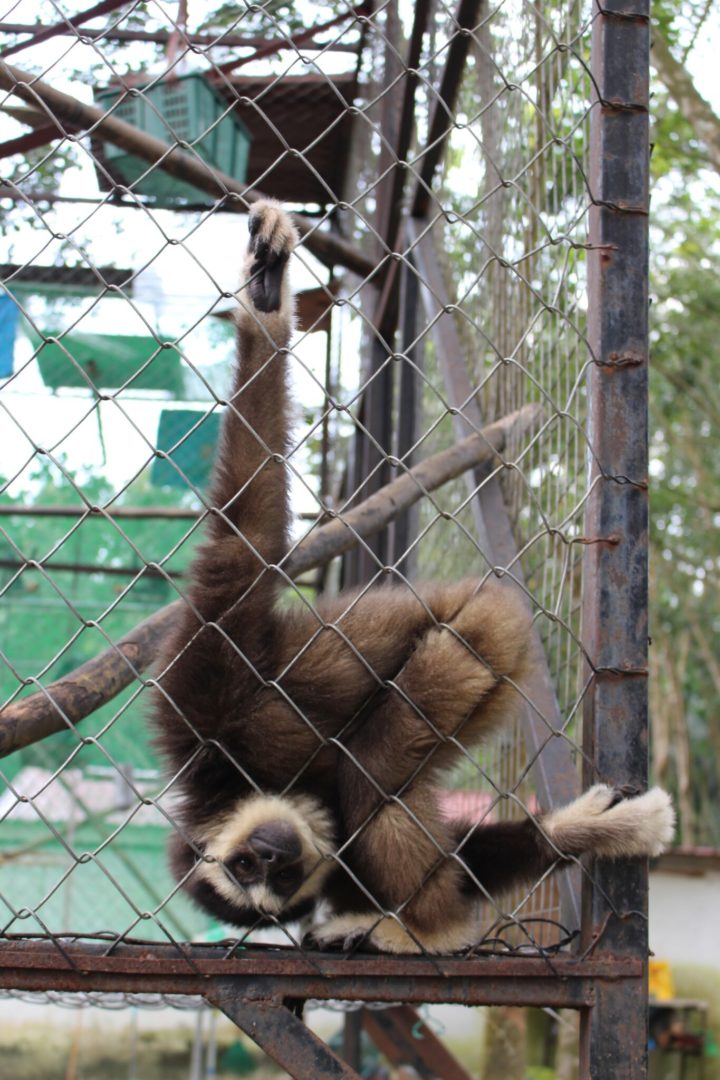
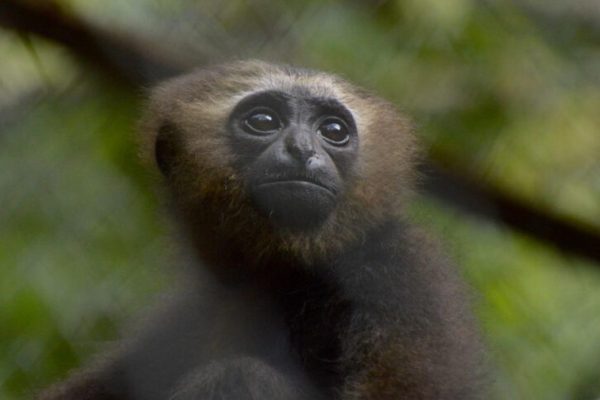
 Different gibbon species, small apes native to Southeast Asia (Photo: Wild Nomads, used with permission).
Why do Gibbons matter?
Gibbons are more than beautiful singers. Their role in the forest remains vital.
As fruit eaters, they have an important role in spreading the seeds of trees across wide areas. By doing this, they help regenerate forests and maintain biodiversity. In ecosystems where larger primates have disappeared completely, the gibbon’s role as a seed disperser is even more important.
In addition, they are indicator species in tropical forests, meaning their health or presence shows the overall condition of their environment. When gibbons disappear, it often means that the whole forest itself is in serious decline. This is why gibbons’ conservation plays a crucial role in protecting tropical forest ecosystems.
Beyond ecology, gibbons are strongly tied to human culture as well. Their songs have inspired folklore and local identity and appeared in ancient poetry. To lose gibbons would not only mean ecological loss and damage, which itself has serious and irreversible consequences, but also cultural silence.

Threats Gibbons Face
The main threat to gibbons is habitat loss.
Across Southeast Asia, rainforests are being cleared for palm oil plantations, agriculture, logging, mining, and infrastructure. Even where forests remain, they are often fragmented by development and roads. Gaps in the forests can be fatal to animals that spend their lives relying on the canopy. And some species have already lost most of their home because of this.
The illegal wildlife trade is another devastating threat. Historically, Indonesia and Vietnam have been the most affected countries in gibbon trafficking. However, recently, there has been a shift towards India and Malaysia. Infant gibbons are highly sought after as pets, but it often means killing the mothers who defend them.
Young gibbons have a long childhood, usually 6 to 8 years, where play is vital for their physical and social development. Through it, they build strength, coordination, and social skills. When they are taken from the wild, they lose this critical stage of learning.
The rehabilitation centres receive rescued individuals who often arrive traumatised, malnourished, and socially deprived. Some have endured years of isolation. Others have been dressed up for tourist photos. Family bonds have been shattered—the characteristic that defines their whole species. These pressures make gibbon conservation one of the most urgent priorities in Southeast Asia.
What Happens After Rescue?
A rescue operation is only the first step. Rehabilitating a gibbon is a complex and time-consuming process, and rehabilitation centres are central to long-term conservation strategies.
Gibbons are highly territorial and social, forming strong pair bonds and relying heavily on vocal communication. A gibbon that has lived in isolation may not know how to interact with its own kind. Some imprint heavily on humans, which makes release back into the wild even more challenging.
In captivity, some gibbons also develop behaviours you would not see in the wild, such as repetitive movements or unusual social responses. These are often signs of prolonged stress or unnatural living conditions. A key part of rehabilitation is helping them shed these habits and rebuild the natural behaviours.
Rehabilitation centres work patiently to:
- Provide proper nutrition
- Rebuild natural behaviours
- Restore physical strength
- Reduce human contact gradually
- Prepare suitable forest release sites
- Carefully introduce compatible partners
Release is only possible if there is a safe, connected forest available. For this reason, it is not just about rescuing but also about protecting and restoring habitat. Every successful gibbon release represents years of dedication and hard work. But nothing compares to the moment of a gibbon swings freely through the forest canopy for the first time.
 The Role of Volunteers in Gibbon Conservation
If you are considering volunteering at a gibbon rehabilitation centre, your role includes a variety of different tasks.
Usually, volunteers assist with:
- Preparing specialised fruit and leaf diets
- Cleaning and maintaining enclosures
- Constructing enrichment devices to encourage natural behaviour
- Observing and recording behavioural data
- Supporting local staff with daily operations
Direct contact with gibbons is normally prohibited in ethical facilities. Minimising human interaction increases the chances that a gibbon can return to the wild and live independently.
Volunteering is not about cuddling animals or exploiting wildlife for social media. It is about giving them space and tools to return home. As a result, you become part of a larger effort to repair what has been broken. Volunteers directly contribute to global gibbon conservation efforts.
Be Part of Gibbon Conservation
For millions of years, gibbons have sung through Asian forests. They have survived climate shifts, geological change, and natural challenges. But the speed and scale of modern human activity present a threat unlike any they have faced before.
But it is not too late.
Communities are protecting lands across Asia. Rehabilitation centres are releasing gibbons back into the wild. Conservationists are restoring forest corridors and building canopy bridges. And people like you are choosing to help. Supporting gibbon conservation means protecting forests, strengthening wildlife laws, and raising awareness worldwide. Every gibbon that returns to the canopy creates a possibility of new generations, new songs, and renewed forests.
Tomorrow at sunrise, somewhere in Southeast Asia, a pair will sing again. It declares territory, partnership, and survival. With the right support, those songs will continue, and we can ensure that the forests of Asia never fall silent.
Our gibbon volunteer program in Bangladesh is working to rescue and rehabilitate gibbons and restore their future in the wild. You can be part of protecting them!
GET IN TOUCH
Related Posts


